Pennsylvania’s solar market has reached a pivotal moment. The state doubled its solar capacity to over 2 gigawatts in just 17 months, enough to power the combined households of Pittsburgh, Allentown, Erie, Scranton, York, and Williamsport. This rapid expansion signals new opportunities for commercial property owners looking to unlock revenue streams.
Nationwide, King Energy stands at the forefront of this transformation. With 200+ solar systems nationwide and over $110 million in added property value since 2021, King Energy understands the unique landscape facing Pennsylvania property owners.
Pennsylvania’s solar market operates under distinctive rules that create advantages for commercial property investments. Understanding these policies, namely the Hommrich Rule and potential community solar developments, enables property owners to make informed decisions about their energy strategy.
The State of Solar in Pennsylvania
Pennsylvania’s solar market has experienced explosive growth, establishing the state as an emerging renewable leader. The commonwealth now ranks 26th nationally for solar installations, with approximately two-thirds of current solar capacity coming from residential and commercial rooftop solar systems.
More than 500 MW of new grid-scale solar projects are under construction throughout the state. This expansion reflects improving economics, increased developer interest, and supportive policies that favor commercial solar adoption.
Pennsylvania maintains a pro-growth environment for solar development. The governor’s “Lightning Plan” has embraced an all-in energy strategy to meet future demand, reduce emissions, create jobs, and maintain grid reliability. This balanced approach provides the stability needed for long-term commercial solar investments.
Despite this progress, solar provides less than 1% of Pennsylvania’s electricity needs. The state estimates that it needs approximately 11 GW of installed solar capacity, five times its current levels, to reach its 10% solar target by 2030. This gap represents a significant opportunity for commercial property owners looking to use renewables for revenue.
Understanding Pennsylvania’s Solar Policy: The Hommrich Rule
The Hommrich Rule represents a landmark legal precedent that dramatically expanded solar opportunities for commercial property owners in Pennsylvania. This 2021 Pennsylvania Supreme Court decision fundamentally changed who can participate in net metering programs.
Before the Hommrich decision, the Pennsylvania Public Utility Commission restricted net metering eligibility through narrow definitions and strict requirements. Solar projects needed to demonstrate “independent load,” meaning they had to serve actual on-site energy needs rather than simply generating power for sale. The system was also capped at 110% of the property’s annual usage, severely limiting project scale.
The Supreme Court ruled that these restrictions exceeded the PUC’s authority under the Alternative Energy Portfolio Standards Act. The Hommrich Rule removed the independent load requirement and eliminated usage-based caps for projects up to 3 MWac capacity.
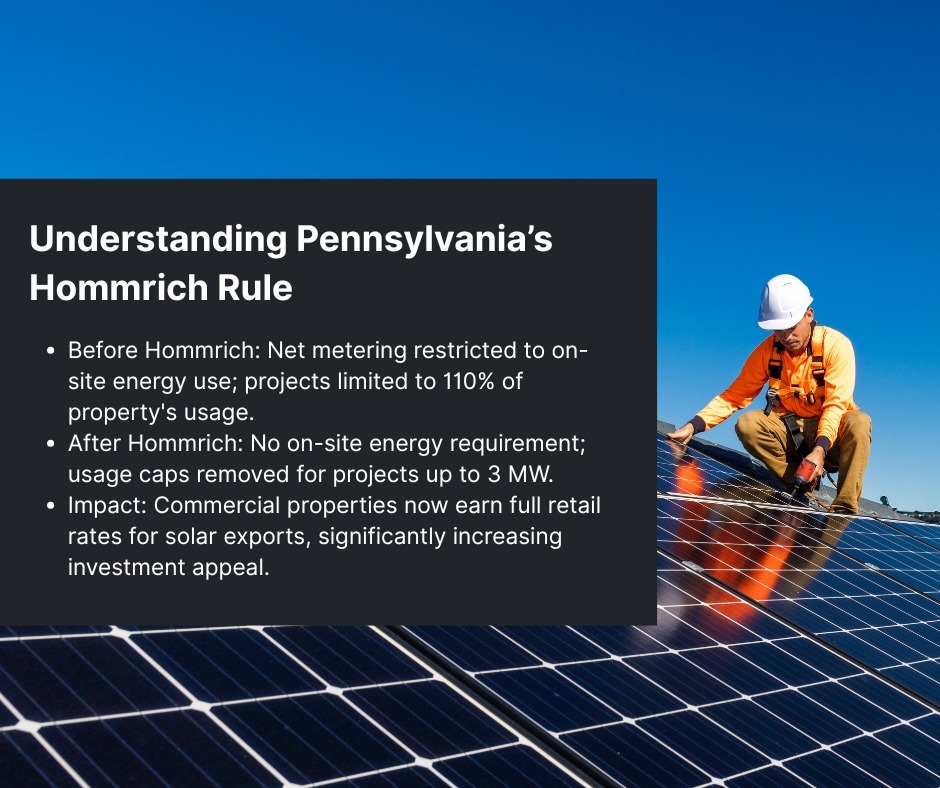
This change created substantial financial advantages for commercial property owners. Any qualifying solar project up to 3 megawatts can now participate in net metering regardless of on-site energy consumption. Solar programs receive full retail electricity rates for every kilowatt-hour exported to the grid—establishing Pennsylvania as an attractive market for commercial solar investment.
Community Solar vs. The Hommrich Rule: What’s the Difference?
Community solar allows multiple subscribers to share benefits from a single solar installation, typically located off-site. Participants receive credits on their electricity bills based on their share of the system’s production. This model has thrived in neighboring states like New York, New Jersey, and Maryland.
Pennsylvania currently lacks legislation for widespread community solar programs. Multiple bills have passed the House but stalled in the Senate, leaving the market in legal limbo. This legislative gap means renters, apartment dwellers, and property owners with unsuitable roofs cannot access solar benefits that are readily available in other states.
The absence of community solar creates a window of opportunity for commercial property owners who can take advantage of the Hommrich Rule. Under the current law, property owners receive full retail rates, at the Price to Compare rate, for exported power. Community solar programs typically offer lower per-kilowatt-hour compensation since benefits are distributed among multiple participants. Property owners who act under current Pennsylvania rules position themselves to maximize returns before potential policy changes.
It is inevitable that Pennsylvania will eventually adopt community solar legislation. The state’s House has continued advancing community solar bills in 2025, and public pressure to align with neighboring states’ policies continues to grow.
What Could Change if Community Solar is Adopted?
Community solar adoption would fundamentally alter Pennsylvania’s solar landscape, creating both opportunities and challenges. Property owners currently benefiting from the Hommrich Rule’s full retail compensation might see revenue models shift toward more shared benefits.
While this creates broader access for residents and businesses unable to install their own systems, it reduces per-kilowatt-hour returns for property owners compared to net metering arrangements. This cuts into any potential profit margins for ownership.
However, community solar expands market opportunities for commercial property owners with suitable sites. Large rooftops and open land could host community solar installations serving multiple subscribers, potentially creating more stable, long-term revenue streams than net metering approaches.
Community solar adoption could also accelerate overall market growth by expanding access to previously excluded populations, but success depends on the specific legislative language. Pennsylvania’s eventual approach will determine which approach becomes more favorable.
Future Outlook for Solar Energy in Pennsylvania
Pennsylvania’s solar future depends on legislative action across multiple policy areas. The state is considering substantial increases to already high renewable energy mandates, with some proposals targeting 14% solar generation by 2030. These aggressive targets would require dramatic expansion beyond current growth rates.
Key policy developments to monitor include community solar enabling legislation, increased Alternative Energy Portfolio Standards, and streamlined permitting processes. The Pennsylvania Solar Future Plan recommends raising the state’s solar requirements to between 4-8% of the electricity mix by 2030, requiring significant investment in both distributed rooftop systems and utility-scale projects.
Property owners should also look out for potential changes to the Hommrich Rule. Some expect policy adjustments as Pennsylvania’s solar market matures, making current opportunities particularly time-sensitive for commercial property investments.
How King Energy Helps Pennsylvania Property Owners
King Energy’s proven solar lease model creates a new source of revenue for commercial properties, without upfront costs or operational complexity. Property owners receive consistent monthly payments for roof space while King Energy handles all installation, maintenance, monitoring, and tenant enrollment responsibilities.
This approach directly addresses the split-incentive challenge that has historically limited commercial solar adoption. While tenants enjoy reduced energy costs, property owners benefit from increased Net Operating Income that translates to higher property values through standard cap rate calculations.
King Energy’s enterprise-grade OneBill™ platform simplifies energy management and reporting for multi-tenant commercial properties. The system streamlines billing processes and provides comprehensive energy usage data, reducing administrative burden while improving tenant satisfaction.
With 88% of participating tenants being small businesses and 48% of systems serving low-to-moderate income communities, King Energy demonstrates how commercial solar creates broad community benefits. The company’s long-term partnership approach ensures ongoing system optimization and performance monitoring throughout the solar installation’s productive life.
King Energy’s nationwide presence across 11 states provides Pennsylvania property owners with proven expertise and financial stability. The company’s track record includes over $550,000 in energy savings generated and 16,000+ tons of CO2 emissions avoided, demonstrating measurable environmental and economic impact.
Capitalizing on Pennsylvania Solar
Pennsylvania’s solar market presents compelling opportunities for commercial property owners, whether through current Hommrich Rule advantages or future community solar developments. The state’s rapid capacity growth and supportive policy environment create favorable conditions for solar investment.
However, policy changes remain likely. The Hommrich Rule may face modifications, and community solar legislation could alter the competitive landscape. Property owners who act decisively under current rules position themselves advantageously regardless of future developments.
Secure your position in Pennsylvania’s evolving energy market